

Originally published 17 August 2026. This educational article reflects its publication date; check current rules and suitability before taking action.
Think of a Chennai business owner who has invested through SIPs for years. He knows his schemes, but cannot remember whether every folio has a nominee. His family knows about only some of the investments.
This is common. We spend time choosing funds and tracking investments, but nomination is often left for another day.
SEBI has now issued a single set of updated rules for nomination in mutual fund folios and demat accounts. The framework comes into effect on September 1, 2026. The final rule is contained in SEBI Circular No. SEBI/HO/OIAE/OIAE_IAD-3/P/CIR/2026/12676 dated May 29, 2026.
Before you worry, please note one important point. September 1 is the effective date of the new framework. It is not a blanket deadline requiring every existing investor to submit a fresh nomination. The action you need to take depends on whether your folio is new or existing, and whether it is held by one person or jointly.
Quick Answer: What Changes from September 1, 2026?
- A new single-holder mutual fund folio must have a nominee, unless the investor formally opts out.
- Nomination remains optional for a jointly held folio.
- An investor can add up to three nominees.
- Existing folios without a nominee are not given a blanket freezing rule under this circular. They will receive reminders and online pop-up messages.

First, What Is Nomination in a Mutual Fund?
A mutual fund folio is the account record created by a mutual fund company for your investments. A nominee is the person named in that folio to help with the transfer process after the death of the unit holder.
This transfer process is called transmission. Nomination helps the mutual fund identify the person who can start the claim process and submit the required documents.
Nomination should not be confused with final inheritance. A nominee does not automatically become the final legal owner only because their name appears in the folio. AMFI explains that a nominee generally receives the units as an agent or trustee for the legal heirs under applicable succession law. A Will and proper estate planning can still be important.
Now, let us look at the seven checks every mutual fund investor should make.
Check 1: Is Your Folio New, Existing, Single or Joint?
This is the first and most important check under the new mutual fund nomination rules 2026.
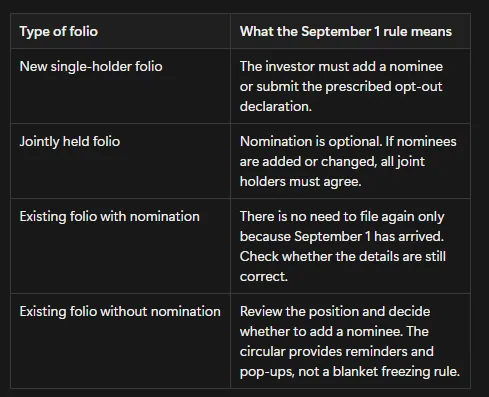
For example, a Coimbatore investor opening a new single folio on September 5 must nominate or formally opt out. Nomination remains optional for an old joint folio.
These are national SEBI rules. Tamil Nadu does not have a separate mutual fund nomination rule.
Check 2: Will You Add a Nominee or Formally Opt Out?
Nomination is the normal choice for a new single-holder folio, but the investor has the right to opt out.
If you do not want to appoint a nominee, you must make that choice clearly. You can submit the prescribed physical opt-out declaration or select the online opt-out option and accept the displayed declaration. Leaving the nomination section blank is not the same as completing a formal opt-out for a new single-holder folio.
Opting out is allowed, but understand what it can mean for your family. Without a nomination, legal heirs may have to submit more legal or court-issued documents, which can delay transmission. Make the choice after a calm family discussion.
Even investors who formally opt out may continue to receive nomination reminders under the new framework. These messages are meant to give investors another chance to review their choice.
Check 3: Have You Chosen the Right Number of Nominees and Shares?
The final 2026 rule allows up to three nominees. Ignore old articles that mention 10 or four nominees. The final May 29 circular sets the maximum at three.
If you name more than one nominee, you may state the share for each person. For example:
- Spouse: 50%
- Daughter: 30%
- Son: 20%
Percentage share is optional. If you leave it blank, the assets will be divided equally among the nominees. Any small balance that cannot be divided equally will go to the first nominee named in the form.
The stated share helps the transfer process, but does not replace a Will or succession plan. Families with large assets, business interests or cross-border members should also take legal advice for estate planning.
Check 4: Are the Nominee Details Complete?
SEBI has reduced the number of compulsory fields. This is meant to make the process easier and reduce mistakes during account opening.
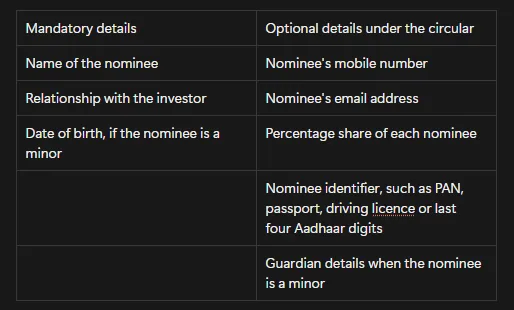
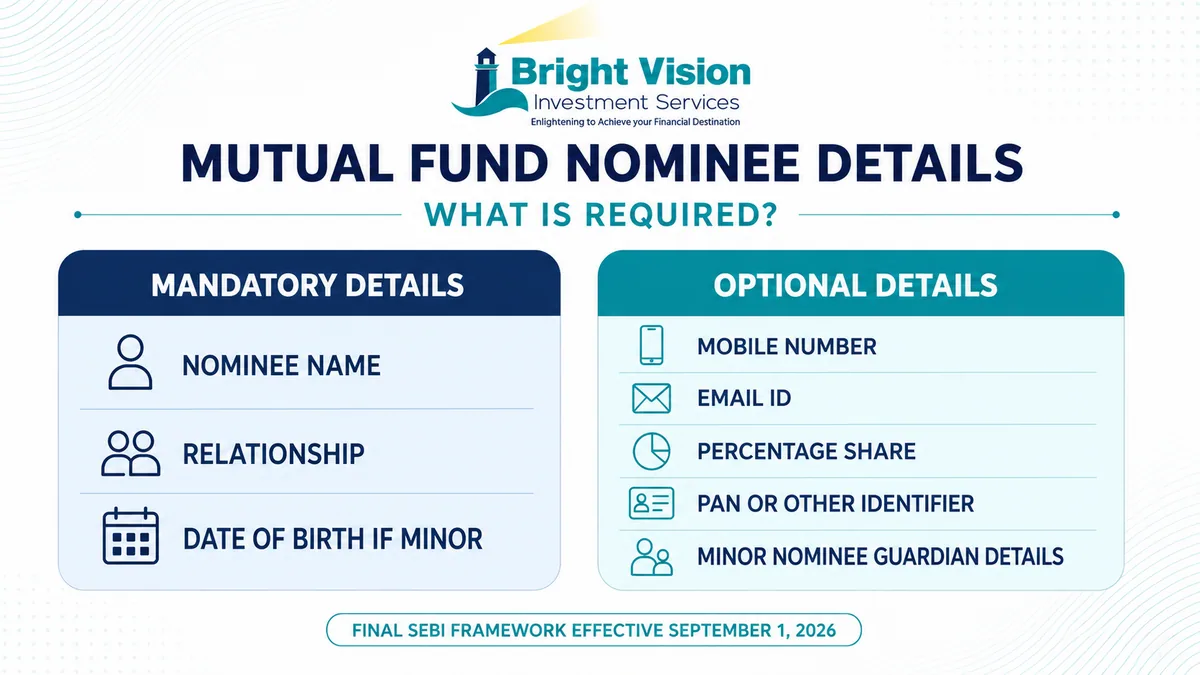
Do not publish or follow advice saying that PAN or Aadhaar is compulsory for every nominee under the final September 2026 rule. The final circular lists the nominee identifier as optional.
A minor can be a nominee, and the minor's date of birth is compulsory. The circular lists guardian details as optional, but the AMC or Registrar and Transfer Agent may ask for information needed for its process.
An RTA is a service company that maintains mutual fund investor records and handles service requests. Submit nominee details only through the official AMC, RTA or authorised platform.
Also remember these special cases:
- A minor may be a nominee, but nomination is not allowed in a folio held on behalf of a minor.
- A Power of Attorney holder cannot make the nomination for the investor.
- Non-individual investors, such as companies, partnership firms and HUFs, do not use this individual nomination facility.
Check 5: Is Your Mobile Number and Email Ready for Online Validation?
Nomination can be submitted online or offline.
For online nomination, the allowed validation methods include a Digital Signature Certificate, Aadhaar-based e-sign, another e-sign recognised under the Information Technology Act, or two-factor authentication. Under the two-factor route, one factor includes a one-time password sent to the investor's registered mobile number and email address.
Before starting, check whether your registered mobile number and email are active. Do not share your OTP, password or full account details with anyone. Use only the official AMC, RTA or authorised service platform.
For a physical nomination form, a normal wet signature does not need a witness. If the investor uses a thumb impression instead of a signature, two witnesses are needed. Their names and addresses must be recorded.
This can help senior citizens who prefer paper forms. Not every physical nomination needs witnesses.
Check 6: Have All Joint Holders Given Consent?
Nomination is optional for a jointly held folio. If joint holders add or change a nominee, all of them must consent, whatever the operating mode may be.
For example, a husband and wife may hold a folio under “either or survivor” mode. One holder may be able to complete certain transactions, but both holders must still agree when a nominee is added or changed.
For a joint folio, the surviving joint-holder process comes first. The nominee normally comes into the picture after the death of all joint holders.
Investors can add, change or cancel nominations any number of times. A fresh nomination replaces the earlier one. The AMC or RTA must acknowledge every request or change. Save it with your family records.
Do not assume an old nominee is still suitable. A marriage, divorce, death, birth of a child or change in family responsibility may be a reason to review the record.
Check 7: Does Your Statement Show the Correct Nomination Status?
Investors can choose whether a periodic statement shows the nominee's name or only “Yes” or “No”.
Check your latest statement instead of depending on memory. If you have investments with several mutual fund companies, review each folio. Do not assume that updating one folio automatically updates every other folio.
For folios without nomination, including opt-outs, Mutual Fund RTAs must send reminders twice a year by email and SMS. The platform must also show a nomination message on the first login of the day. This provision excludes investors who have provided a nomination.
If you receive a reminder, do not click an unknown link. Open the official AMC or RTA website or app separately and check your folio there.
A Simple Seven-Step Action List for Existing Investors
You do not need to panic or submit a new form without checking your records. Use this order:
- Prepare a list of all your mutual fund folio numbers.
- Mark each folio as single-held or jointly held.
- Check whether nomination shows as “Yes”, “No” or with a nominee name.
- Confirm that the current nominee still matches your family plan.
- Check the spelling, relationship and minor nominee's date of birth.
- Update through the official AMC, RTA or authorised platform if a change is needed.
- Save the acknowledgement and tell a trusted family member where the records are kept.
This review is useful for business owners, HNI families and anyone with many old folios.
What Should NRI Mutual Fund Investors Check?
The May 29 circular gives NRIs no separate exemption. First check whether the folio is single or joint and whether nomination is already recorded.
If you live outside India, make sure your registered mobile number and email can receive the online authentication message. If not, ask the AMC or RTA about its offline process.
AMFI guidance permits an NRI to be a nominee, subject to applicable exchange-control rules. Check the latest AMC requirements before submitting the form. Do not assume that every AMC follows the same service process.

Frequently Asked Questions About the New Mutual Fund Nomination Rules 2026
1. Is September 1, 2026 a deadline for every existing mutual fund investor?
No. It is the date on which the new framework takes effect. The SEBI circular does not order every existing investor to file a fresh nomination by that date. Existing investors should check their current status and update it if needed.
2. Will my existing mutual fund folio be frozen if it has no nominee?
The May 29, 2026 circular does not prescribe freezing an existing folio simply because nomination is missing. It requires reminders and online pop-up messages for folios without nomination, including opt-outs.
3. Can I add 10 nominees to a mutual fund folio?
No. Under the final framework effective from September 1, 2026, an investor can name up to three nominees.
4. Is PAN or Aadhaar compulsory for a nominee?
No. The final circular lists the nominee's personal identifier as optional. The nominee's name and relationship are mandatory. Date of birth is also mandatory if the nominee is a minor.
5. Can a minor be a mutual fund nominee?
Yes. A minor can be a nominee. The minor's date of birth must be provided. Check the form and AMC process for any other details required to handle the request.
6. Can a new single-holder investor opt out of nomination?
Yes. The investor must complete the prescribed opt-out declaration physically or accept the online opt-out declaration. Simply leaving the field blank is not enough for a new single folio under the new framework.
7. Do all joint holders need to approve a nominee?
Yes. All joint holders must consent when providing or changing nomination, even if the folio has a different operating mode.
8. Does a nominee automatically become the final owner of the mutual fund units?
Not merely because of nomination. Nomination supports the transmission process. Final ownership can depend on the Will and applicable succession law. Families should take legal advice where inheritance is complex or disputed.
Final Word
The new mutual fund nomination rules 2026 aim to make the process clearer. Start by checking how many folios you have, which are single or joint, and whether the recorded details are correct.
A nomination cannot prevent every family dispute, and it cannot replace proper estate planning. Still, a clear and updated folio record can make it easier for the family to begin the transmission process when needed.
Need help checking the nomination status shown in your mutual fund folio or finding the applicable AMC or RTA form? Bright Vision Investment Services can explain the service steps and help you locate the official channel. Call +91 90033 87104 or visit www.brightvision.co.in.
Important Investor Note
This article is for general investor awareness and educational use only. It is not investment, legal or tax advice. Nomination does not replace a Will or the requirements of applicable succession law. Rules, forms and service processes may change. Investors should verify the latest process with the relevant AMC, Mutual Fund RTA or authorised platform before acting.
Mutual Fund investments are subject to market risks, read all scheme related documents carefully.
Official References Used for Fact-Checking
- SEBI: Ease of doing investments, Modified Norms for Nomination in Demat Accounts and Mutual Fund Folios, May 29, 2026
- SEBI Circular PDF: SEBI/HO/OIAE/OIAE_IAD-3/P/CIR/2026/12676
- AMFI: Nomination in Mutual Funds
- AMFI: Procedure to Claim Units or Proceeds upon Death of a Unitholder
Explore more perspectives or talk to Bright Vision about your financial goals.
Explore all insights