

Originally published 24 October 2026. This educational article reflects its publication date; check current rules and suitability before taking action.
The payment that can be misunderstood
A credit from a mutual fund can feel like a bonus. You still see units in your account, and money has also arrived in your bank. It is understandable to assume you now have both the original investment and an extra return.
Before reaching that conclusion, look at what happened to the value of the units. A distribution moves value out of the scheme. The bank credit needs to be read together with the remaining holding, not on its own.
Growth and IDCW are different ways of handling distributions within a mutual fund scheme. Understanding that distinction helps you read an application form, question a sales explanation and make a more informed decision about cash flow. It does not tell you which fund to buy, and neither label promises a positive return.
Key takeaways
Growth and IDCW describe how distributions are handled, not a guarantee of investment growth or income. An IDCW payout must be assessed together with the value remaining in the fund.
Reinvestment can add units without creating an extra gain at that moment. Check the exact scheme, plan, option and facility, then review your cash-flow needs and obtain appropriate tax guidance before making a change.
What does IDCW mean?
IDCW stands for Income Distribution cum Capital Withdrawal. The name matters because a distribution can include amounts from investors’ capital through the equalisation reserve, rather than representing only fresh investment profit.
Scheme disclosures explain that the reserve can contain the part of the unit sale price representing realised gains. You do not need to become a fund accountant to understand the practical message: a payment described as IDCW should not automatically be treated as additional wealth.
An IDCW option may offer payout, reinvestment or other facilities specified in its documents. Availability and operating conditions are scheme-specific. Check the current Scheme Information Document, Key Information Memorandum and relevant addenda, rather than assuming that a facility available in one fund exists in another. The AMFI-hosted scheme disclosures illustrate why the exact option and default instructions matter.
What happens under the growth option?
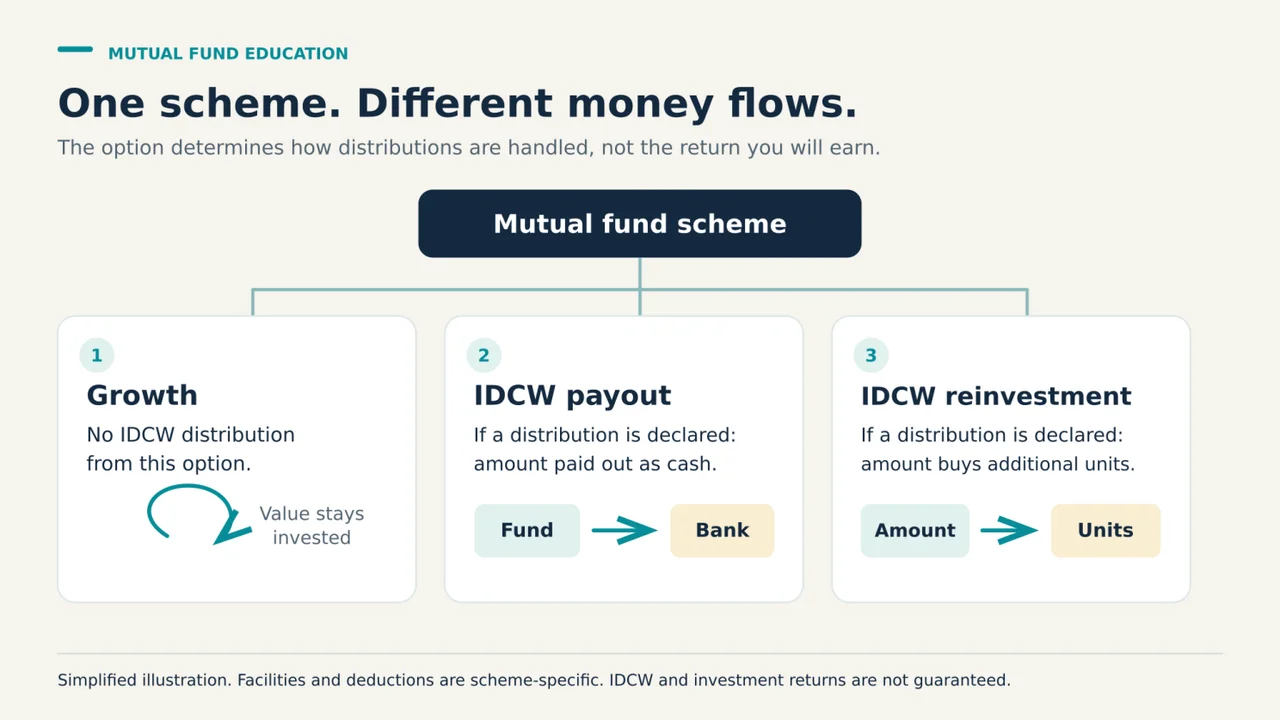
Under growth, the scheme does not make IDCW distributions from that option. The value of the investments, after the scheme’s expenses and liabilities, is reflected in its net asset value, or NAV. Gains remain within the investment instead of being paid out as IDCW.
The word “growth” describes the option’s structure. It is not a prediction that your account will rise every month. If the underlying investments lose value, a growth option can lose value too.
AMFI’s investor-awareness presentation explains the distinction between retaining gains and distributing them. For your own planning, separate the question “Do I need money paid out?” from “Can I tolerate the risks of this scheme?” Choosing an option cannot repair a mismatch between the scheme’s risk and the purpose of your money.
A simple example: where the money goes
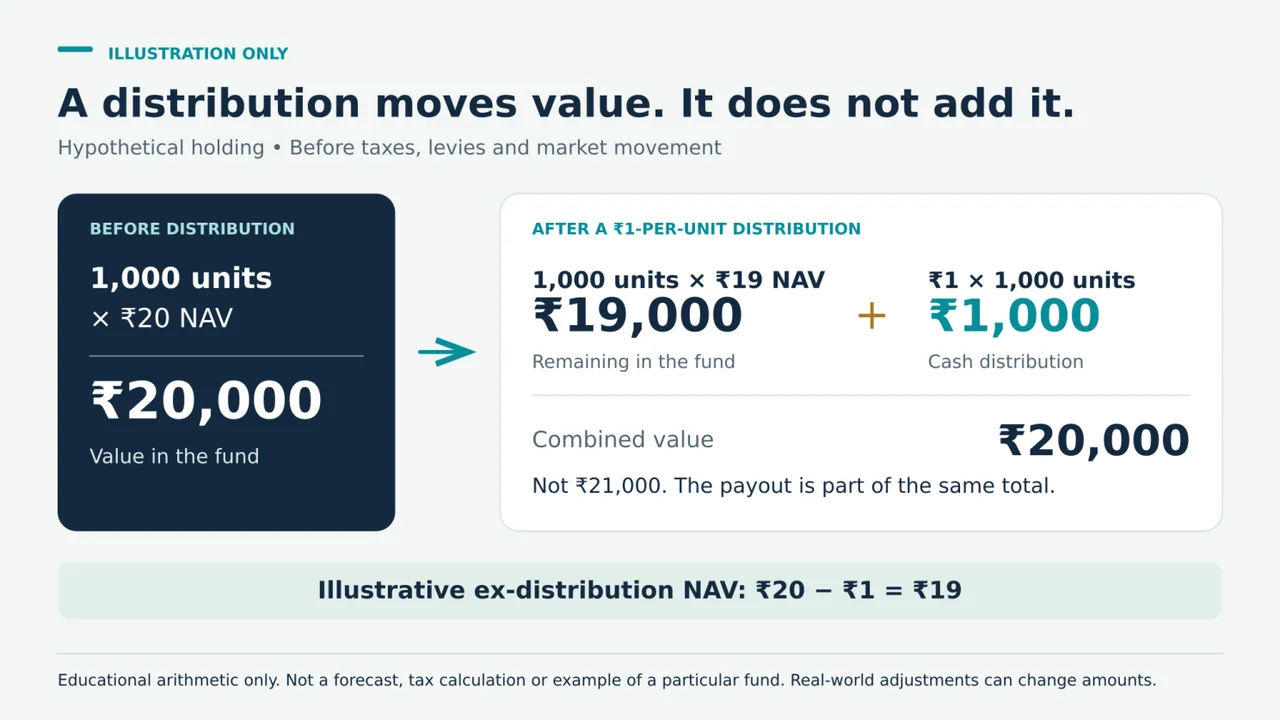
Consider a deliberately simplified, hypothetical holding of 1,000 units at a NAV of ₹20. Its value is ₹20,000. Suppose the scheme declares an IDCW distribution of ₹1 per unit. The gross distribution attributable to this holding is ₹1,000.
If we ignore market movements, taxes and other applicable adjustments, the illustrative ex-distribution NAV becomes ₹19. The same 1,000 units are then worth ₹19,000. Add the ₹1,000 distribution, and the combined amount remains ₹20,000.
The purpose of this arithmetic is to explain the movement of value. It is not a forecast, a tax calculation or an example of a particular fund. In a real account, market changes and applicable deductions can affect the figures you see.
The useful habit is simple: whenever a distribution arrives, check both the payment and the holding after the distribution. Looking only at the bank credit leaves half the picture out. Scheme disclosures hosted by AMFI explain the reduction in IDCW NAV associated with a distribution.
Payout and reinvestment are different instructions
With IDCW payout, the declared amount is paid out, subject to the scheme’s rules and applicable deductions. With IDCW reinvestment, the amount available for reinvestment buys additional units at the applicable NAV. The second arrangement can increase your unit count without creating an equivalent windfall.
Returning to the simplified example, reinvesting ₹1,000 at ₹19 would buy approximately 52.632 additional units before any real-world adjustments. Around 1,052.632 units at ₹19 would still represent approximately ₹20,000. The extra units replace value distributed from the original holding.
Do not compare two accounts using unit count alone. One account may have received cash, while another used a distribution to acquire units. AMFI-hosted disclosures describe payout and reinvestment as separate facilities. For an actual transaction, verify the applicable option, rounding, minimum-payment rules and statement entries with the fund.
Is an IDCW payment guaranteed?
No. An option’s name, a past payment pattern or a frequency label should not be read as a guaranteed income commitment. Declarations depend on the scheme’s distributable surplus and the trustee’s decision under the applicable framework.
A household budget becomes fragile if an uncertain distribution is treated like an assured salary. Ask what you would do if the next payment were smaller, delayed or not declared. This question is especially important when the money is expected to cover rent, school fees or another fixed obligation.
The scheme disclosure filed with SEBI explicitly notes that IDCW is not guaranteed and is subject to distributable surplus. This is a structural warning, not a prediction about any particular scheme. Avoid choosing an investment merely because someone points to a recent payout and describes it as dependable income.
Why the lower NAV is not a bargain signal
An IDCW option can show a lower NAV than a growth option after distributions. That difference does not, by itself, make the IDCW option cheaper or more attractive. Part of its value may already have been distributed.
Imagine comparing two water containers after some water has been poured from one into a glass. Looking only at the water left in the containers misses the amount now in the glass. The same completeness check helps when reading distributions and remaining investment value.
SEBI’s NAV explanation notes that a higher NAV does not necessarily mean a better-performing fund. Equally, a lower NAV is not evidence of an investment bargain. Ask for a fair comparison that includes distributions and uses the same relevant period, rather than comparing the two displayed NAV numbers in isolation.
Keep plan, option and scheme separate
An application may ask you to select several things. The scheme identifies the investment product. Direct or regular identifies the plan. Growth or IDCW identifies the distribution option. IDCW payout or reinvestment may then identify a further facility.
These choices answer different questions. Someone can understand the growth-versus-IDCW distinction and still select the wrong plan or even a similarly named scheme. Read the complete selection back before submitting an instruction.
A useful personal record contains the exact scheme name, plan, option, folio reference and date of the instruction. After processing, check that the confirmation matches. If a selection is unclear, resolve it before investing rather than relying on a presumed default. The AMFI-hosted scheme information document provides an example of plans, options and default selections being specified separately; other schemes can have different instructions.
Questions to ask before choosing
Start with the purpose of the money. When might you need it? Are you accumulating towards a future expense, or trying to meet ongoing spending? How much uncertainty can your household absorb without selling investments at an inconvenient time?
Next, ask the person explaining the product to walk through one distribution using numbers. What happens to NAV? What reaches the bank? What happens if no distribution is declared? A clear explanation should account for all the value, rather than spotlighting only the attractive part.
Finally, ask which official documents support the explanation. Keep a copy of the option details you reviewed. This small step makes later conversations easier because you can refer to the same instructions, rather than reconstructing a discussion from memory. These questions are a decision-preparation checklist, not a recommendation for either option or any particular scheme.

Leave room for a proper tax review
Do not assume that growth, IDCW payout and IDCW reinvestment produce identical tax consequences. Equally, do not assume that reinvesting a distribution automatically makes it tax-free. The tax result needs to be checked under the rules applicable to the investor and the transaction.
Before acting, ask a qualified tax professional what treatment applies to your circumstances, what records to retain and whether any deduction at source settles the full liability. This article deliberately does not provide a universal tax rate or threshold.
Bring the scheme details and transaction history to that discussion. A screenshot showing only a fund’s shortened name may omit the option or dates needed for a useful answer. Keeping the evidence together is more practical than making a choice from an isolated claim that one option is always “better for tax.”
Thinking about changing an existing holding?
Pause before treating an option change as a harmless label edit. Ask the AMC or the relevant service provider how the proposed change will be processed and what consequences need review. Check the applicable scheme documents and obtain tax guidance before authorising it.
Also distinguish changing existing units from changing future investment instructions. You may need to ask separately about an existing holding, an ongoing investment arrangement and any reinvestment setting. Do not assume that changing one automatically changes the others.
Write down the intended outcome in plain language: which holding should change, which future instruction should change, and from when. Then compare that request with the transaction confirmation. This is an operational safeguard, not a suggestion that you should switch. If the current arrangement still fits its purpose, understanding it better does not create a need to transact.
A five-minute review you can actually finish
Open one holding and find its full name. Identify the plan and option. If it is IDCW, check whether payout or reinvestment is recorded. Locate the latest official scheme document and any relevant notice. Note one question you cannot answer confidently.
If you have received a distribution, place the statement and bank record together. Check the gross amount, deductions where shown, units and remaining value without assuming that every change came from the distribution alone.
That is enough for a useful first review. You do not need to redesign a whole portfolio in one sitting. The immediate aim is to understand what you own, how money moves and which questions need professional clarification before any decision.
Keep the takeaway simple
Growth retains value within the investment rather than paying IDCW. IDCW may distribute value as cash or reinvest it according to the selected facility. Neither creates guaranteed returns, and a distribution needs to be considered alongside the remaining holding.
Educational information from Bright Vision Investment Services. This article is not personalised investment or tax advice and does not recommend a scheme or option. Mutual fund investments are subject to market risks; read all scheme-related documents carefully. Source pages were checked on 21 October 2026. Verify the current documents before acting.
Save the checklist and bring your unanswered questions to a qualified professional before changing an investment.
Sources and further reading
- AMFI investor awareness presentation
- AMFI-hosted scheme disclosures: option instructions
- AMFI-hosted scheme disclosures: distribution and NAV
- AMFI-hosted scheme disclosures: payout and reinvestment
- SEBI-filed scheme document: IDCW not guaranteed
- SEBI Investor: NAV
- AMFI-hosted scheme information: plans and options
Explore more perspectives or talk to Bright Vision about your financial goals.
Explore all insights