

Originally published 1 November 2026. This educational article reflects its publication date; check current rules and suitability before taking action.
A longer fund list can still contain the same investments
Your investment statement contains several mutual fund names. Some belong to different fund houses, and each was added for a reason. It feels reasonable to assume that the growing list has made the portfolio more diversified.
The next question is what those funds actually own. Two schemes can hold many of the same securities or have similar exposure to a sector, market segment or investment style. A new name on the statement may therefore add less variety than expected.
Mutual fund overlap is a useful subject for families and business owners in Chennai and across Tamil Nadu who want to understand their existing holdings. This article explains how to read through the names and ask better review questions. It does not recommend buying, switching or redeeming any particular scheme.
A useful review question: “What does this fund add to the portfolio I already have?”
What overlap means
At its simplest, overlap occurs when two or more funds hold some of the same securities. It can also be useful to examine broader similarities, such as repeated exposure to one sector or a common investment approach. These are related questions, but they are not identical measurements.
A comparison of common stock names tells you something about holdings. It does not, by itself, describe every risk in the combined portfolio. The weights of those holdings and the amount you own in each fund matter too.
SEBI's investor guidance explains diversification as a way to reduce the impact of poor performance in a single investment. It also places investment choices within goals, risk tolerance and time horizon. Adding schemes should therefore be considered within a portfolio plan rather than treated as a diversification result on its own.
Start with information from the same period
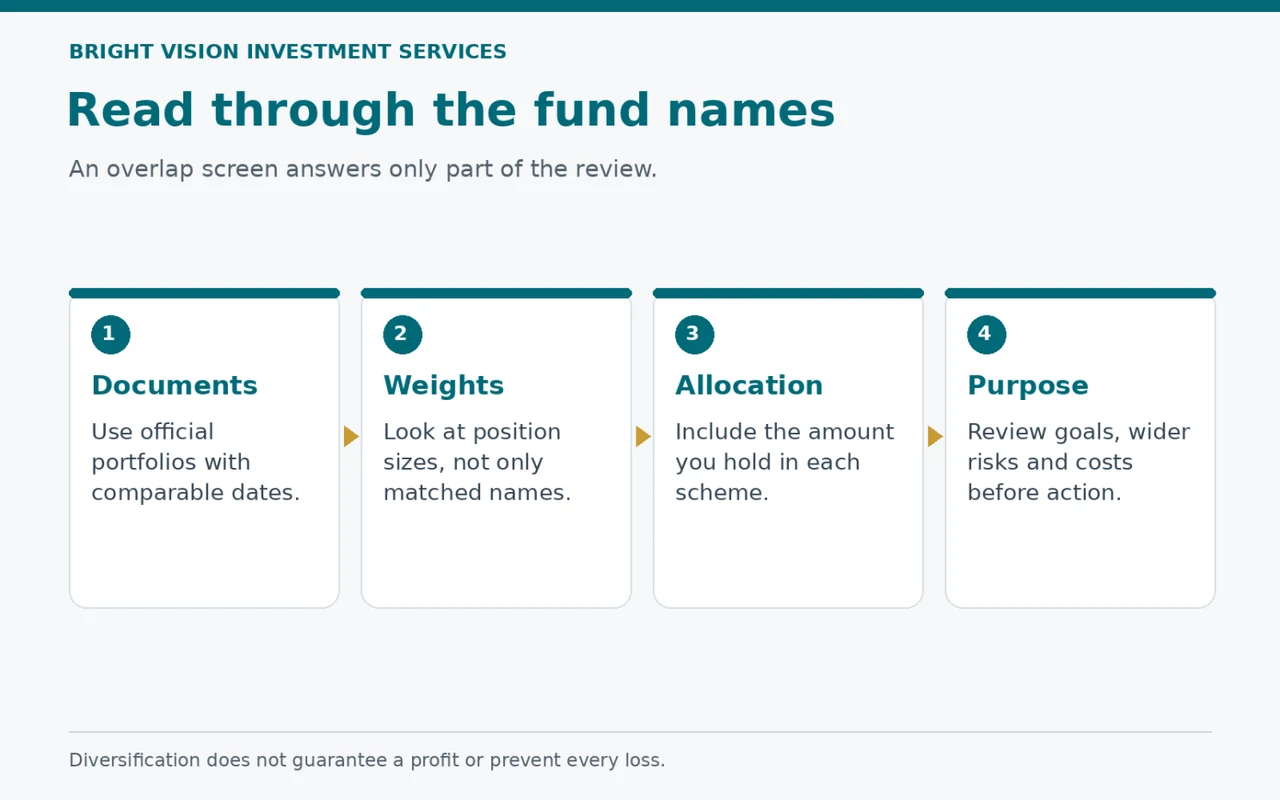
Collect the official factsheets and portfolio disclosures for the schemes you want to compare. Check their reporting dates. A comparison between one fund's current portfolio and another fund's much older holdings can create a misleading impression.
AMFI describes a fund factsheet as a regular source of information about a scheme, including its portfolio, objective, expenses and performance. Use the relevant documents from the fund house rather than relying entirely on an image circulating in a social-media group.
Record the source and date beside your notes. Active portfolios can change. A useful review states what the available snapshot shows and avoids presenting it as a permanent feature of the fund.
Look beyond the top ten names
Top holdings are a convenient starting point, but a partial list cannot establish the complete picture. Find the fuller portfolio disclosure where needed and understand which assets it includes. Check how cash, other securities and any relevant underlying fund holdings are presented.
Make sure that apparently similar names refer to the same security or issuer before combining them. Conversely, different instruments can sometimes create related economic exposure. A specialist may need to interpret holdings that a simple name-matching tool cannot capture well.
Keep the task proportionate. You do not need to turn a household review into a daily research operation. The aim is to identify meaningful repeated exposure and questions worth discussing, with enough detail to avoid a superficial conclusion.
The weights matter more than a count
Suppose two funds share several stock names. Those names might represent small positions in one scheme and major positions in the other. Counting the matches gives each name equal importance, even though the financial exposure is different.
The value you hold in each fund adds another layer. A large position in one scheme and a small position in another do not contribute equally to your combined exposure. Read both the fund's holding weight and your allocation to that fund.
This is why one overlap percentage should not become an automatic instruction to act. Ask what it measures, which holdings were included, what date it uses and how it relates to your actual portfolio.
A small calculation makes the idea clearer
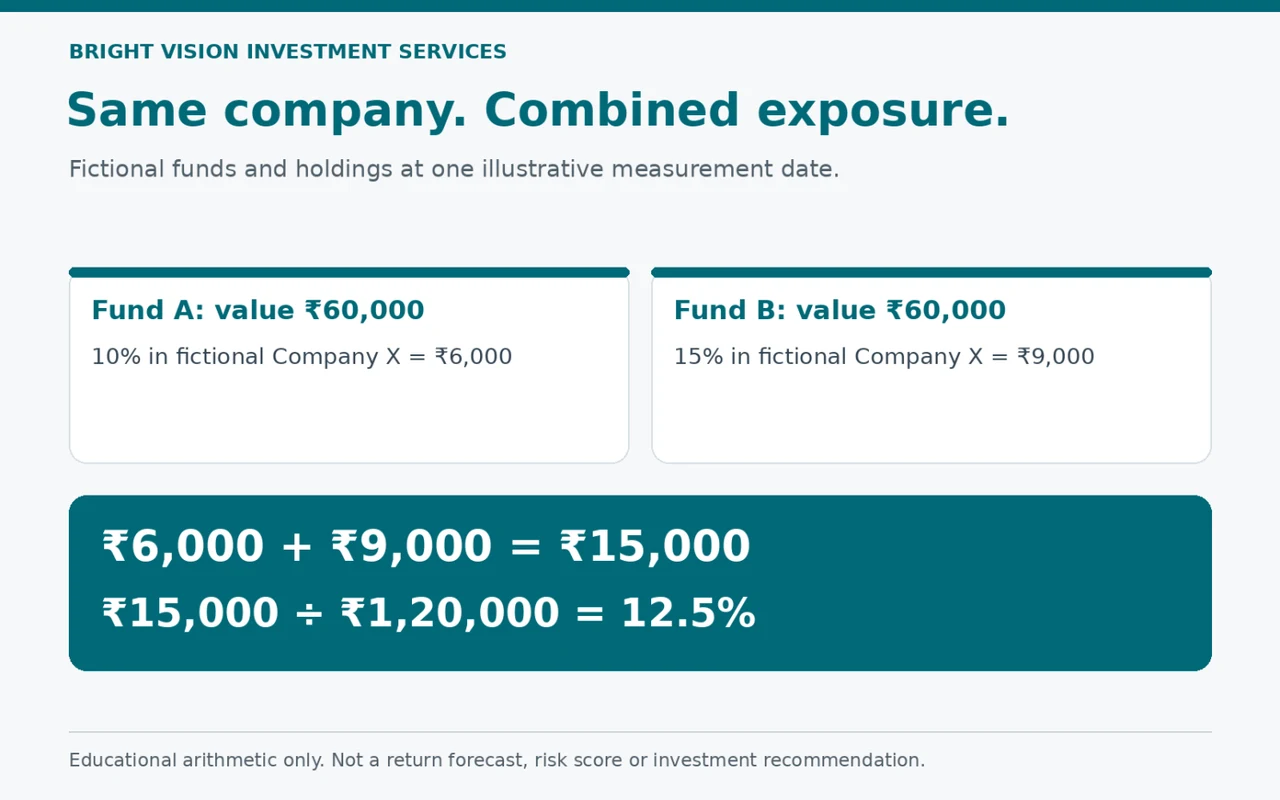
Consider a fictional example at one illustrative measurement date. You hold Fund A worth ₹60,000 and Fund B worth ₹60,000. The combined value of these two holdings is ₹1,20,000. These are invented funds and figures, with no return assumption.
Fund A has 10% of its portfolio in fictional Company X. Your indirect exposure through Fund A is therefore ₹6,000. Fund B has 15% in the same company, producing ₹9,000 of indirect exposure through that holding.
Together, the two positions give ₹15,000 of exposure to Company X. That is 12.5% of the ₹1,20,000 combined value. This is a simplified look-through calculation for one company, not a complete risk assessment or a forecast.
If the amounts held in the funds change, the combined exposure changes even when their published portfolio weights stay the same. The example shows why the investor's allocation belongs in the conversation.
Common holdings are not automatically a mistake
Funds investing within similar markets or mandates may reasonably share some securities. A comparison should ask whether the repetition fits the intended role of each scheme. The presence of a common holding alone does not establish poor management or an unsuitable portfolio.
Different schemes may also approach the same company with different position sizes and wider portfolios. Review the complete context rather than labelling a fund redundant after finding one familiar name.
There is no universal overlap figure that tells every investor how many schemes to own. A useful decision depends on the goals, the overall allocation, the risks accepted and the practical ability to monitor the holdings.
Check concentration at more than one level
Repeated stock names are only one possible concentration. Funds with few identical holdings can still depend heavily on the same sector or market conditions. A household may also have direct shares, employer-linked wealth or business exposure that is absent from the mutual fund statement.
SEBI's material on sectoral and thematic funds highlights the concentration that can arise from a narrower investment focus. Read the scheme's mandate and risk information alongside the holdings, with particular care when a new fund repeats an exposure the household already has.
Diversification can help manage risk, but it does not guarantee against loss. A portfolio of different names can still fall together in a broad market decline. Keep that limitation visible when assessing what a review can achieve.
Give each scheme a stated role
Write a short sentence beside each holding explaining why it is there. The role might relate to a particular goal, an intended asset allocation or a defined part of the investment strategy. If the reason is simply that the fund performed well recently, the holding deserves a fuller discussion.
Compare that intended role with the current scheme documents. Has the household's goal changed? Has the portfolio grown through several uncoordinated purchases? Are multiple schemes trying to perform the same job without a clear reason?
The review may confirm that some repetition is acceptable. It may also identify an unnecessary complication. Either conclusion is stronger when it follows an explicit purpose rather than a desire to reach an arbitrary fund count.
A fictional family review
Imagine a family that adds a new equity scheme after each promising market conversation. Over time, the list becomes difficult to explain. This is a hypothetical example, not a Bright Vision Investment Services customer case or a reported investment outcome.
The family first collects the official documents and records the value held in each scheme. It identifies common holdings and similar mandates, then connects the schemes to its actual goals and wider assets.
The immediate result is a clearer set of questions. It does not automatically follow that the family should sell the overlapping funds. Any proposed change needs a separate review of suitability, costs, tax implications, restrictions and the consequences for the overall plan.
Use comparison tools with an explanation
A calculator can make a holdings comparison faster. Ask which portfolio date it uses, whether it compares full holdings or a subset, and how it calculates the displayed figure. Keep a copy of the underlying official disclosure.
Do not rank two portfolios solely by whichever tool gives the lowest overlap number. The tool may answer a narrower question than the one the household needs to resolve. Interpretation matters as much as the calculation.
Before changing an existing holding, obtain an appropriate review of the complete situation. A switch or redemption can have costs, tax consequences or restrictions that a holdings-overlap screen does not show.
A practical review pack
Bring the scheme names, current holding values, official portfolio dates, intended goals, wider assets and your unanswered questions to the discussion. Keep personal account details secure when sharing records.
Bright Vision Investment Services shares this educational guide to support clearer conversations about mutual funds. Understanding what lies beneath a fund name is a useful step toward a portfolio that can be explained, monitored and reviewed against its purpose.
www.brightvisioninvestment.com
Investor note: This is general educational information, not a personalised investment recommendation. Mutual fund investments are subject to market risks. Read the relevant scheme documents carefully. Diversification does not assure a profit or protect against every loss.
Sources and further reading
- SEBI Investor: Factors to consider before investing
- SEBI Investor: Sectoral and thematic funds
- SEBI: Financial Education Booklet
- AMFI: Reading a fund factsheet
Explore more perspectives or talk to Bright Vision about your financial goals.
Explore all insights