

Originally published 23 September 2026. This educational article reflects its publication date; check current rules and suitability before taking action.
A portfolio can look simple on an app and still be difficult to reconcile on paper. One investment appears under a different folio, another uses an unfamiliar scheme name, and a bank debit does not seem to match the transaction date. Before making a new investment decision, it helps to understand the record of what you already hold.
This guide is for salaried investors, families and business owners in Chennai and across India who want a more organised statement-review routine. It explains how to read a mutual fund consolidated account statement, commonly called a CAS, and prepare clear questions when something does not match.
Quick answer: Confirm the statement source and period, check investor and holding details, identify each scheme precisely, reconcile transactions and closing units, and investigate discrepancies through the relevant official service channel. A statement is a record to understand; it is not, by itself, a recommendation to buy or sell.

First identify which statement you have
Documents described as consolidated statements may be produced through different systems and may cover different holdings. A mutual fund statement requested through registrar services is not automatically identical in scope to a depository statement that includes securities held in demat form.
AMFI describes an electronic consolidated mutual fund statement facility provided collaboratively through CAMS and KFintech. Start from an official provider or a verified link from the relevant institution, and read the document's own scope and notes. Do not assume every account associated with your household will appear in one file.
Record the statement type, issuing organisation, date range and generation date. Those four details often explain an apparent mismatch before any calculation is needed. A document generated yesterday may still describe holdings at an earlier reporting date.
Check the investor details before the amounts
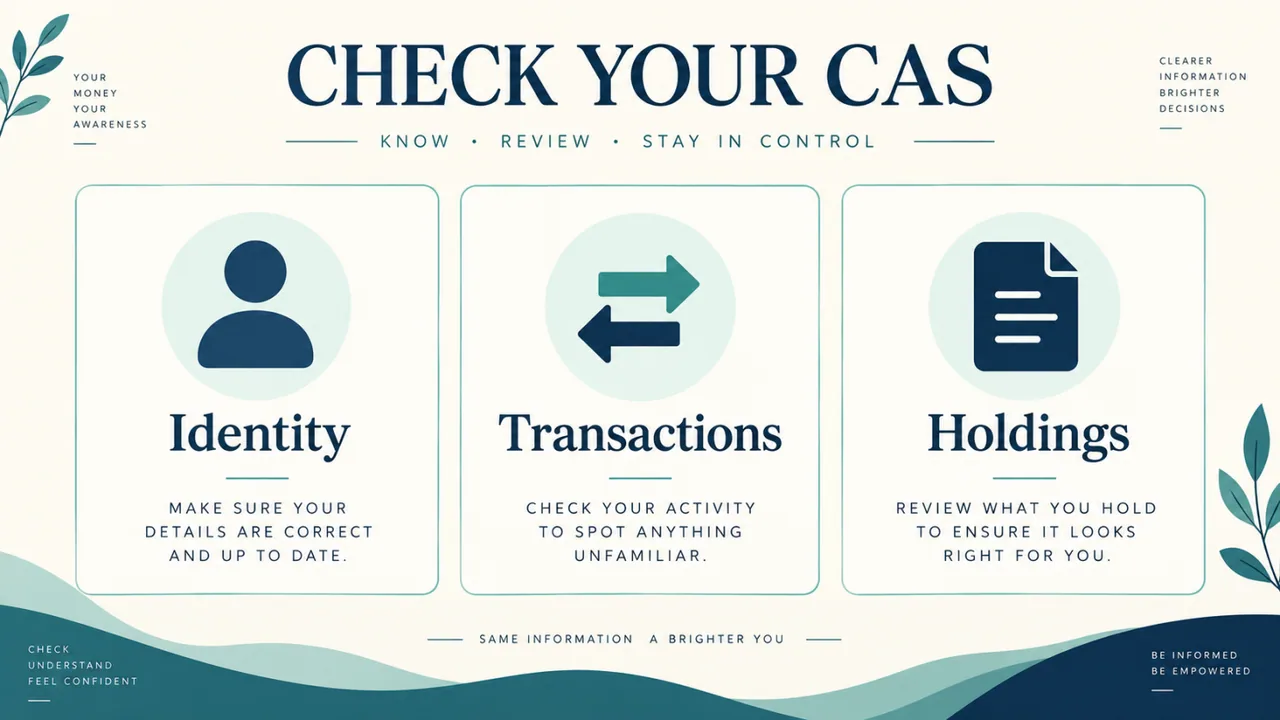
Review the name, masked identifiers where shown, contact information and holding pattern. A statement for an individual holding and a joint holding should not be casually combined as though their ownership details were identical.
If information appears incorrect, use the appropriate official correction process. Do not simply edit your personal spreadsheet and assume the institution's record has changed. Keep the acknowledgement and follow the request until the corrected record is available.
For a family review, organise documents with the account holder's permission. Financial statements contain personal information. Sharing a full file in a large messaging group or uploading it to an unfamiliar website is not necessary just to ask a basic question about a column heading.
Understand folios and scheme names
A folio is an account reference within the fund-house context. One investor can have several folios. Seeing more than one does not automatically mean there is an error, and seeing one folio does not imply it contains only one scheme.
Read the complete scheme description, including the plan and option where shown. Similar names can conceal important distinctions. Avoid shortening them in your worksheet until you have preserved the full official name in a reference column.
If a scheme name has changed, check official communications rather than assuming the holding has disappeared or a new investment has been made. Ask for help mapping the old and current names when necessary. The objective is a clean record, not a hurried conclusion based on a familiar word.
Separate money movements from unit movements
An investment transaction involves both an amount and a number of units. Redemptions, switches and other entries can affect the record differently. Read the transaction description before deciding whether an entry represents new money, money leaving or a movement between schemes.
In your worksheet, use separate columns for date, description, amount and units. This prevents a common mistake: treating every positive amount as fresh investment or every reduction in one scheme as money withdrawn to the bank.
For unfamiliar entries, keep the wording exactly as it appears and ask the registrar, fund house or relevant service provider to explain it. A precise question with a transaction reference is easier to investigate than “my total seems wrong.”
Reconcile units before comparing market values
Start with the opening units. Add the units credited and subtract the units debited during the period, allowing for the statement's rounding and relevant adjustments. Compare the result with the closing unit balance.
For illustration only, an opening balance of 100 units plus 10 purchased units minus 8 redeemed units leaves 102 units. This arithmetic checks a record; it does not measure investment performance. Actual statements can contain other transaction types that need separate interpretation.
If the units do not reconcile, do not force the spreadsheet to balance with an unexplained adjustment. Check whether you have omitted a page, used the wrong period or mixed two schemes. Preserve the original statement and document the remaining question.
Read valuation dates carefully
A holding value is tied to a valuation basis and date. An app showing a later value may differ from an older statement even when the units agree. Compare like with like before treating the difference as an error.
Where the document shows units and a net asset value, understand how these relate to the reported value and any rounding. Keep the number of decimal places visible during your initial check. Rounding every line too early can create small apparent discrepancies.
Do not interpret a larger closing value as proof that all the increase is investment gain. Additional purchases can increase the total. Similarly, a lower total after a redemption does not mean the whole reduction was a market loss.
Match bank entries without expecting identical dates
Use bank records as supporting evidence, but remember that a debit date, transaction-processing date and statement-reporting period can differ. Examine the transaction status and relevant confirmations before deciding that a payment is missing.
Make a small reconciliation list containing the bank reference, amount, approximate date and related folio or scheme. Share only the information needed with the official support channel. Never disclose passwords or one-time codes to someone claiming they can “find” the investment.
If a transaction is recent, check the provider's stated processing guidance. If it remains unexplained, raise a clear service request and keep the reference number. Avoid submitting duplicate requests through many channels without tracking which team is handling the issue.
Illustrative case study: a family reviews three different totals
Imagine a fictional Chennai household comparing a bank statement, an investment app and a CAS. The bank shows a monthly debit near the end of the month. The CAS ends before the associated transaction appears, while the app displays a later valuation date.
Instead of concluding that units are missing, the family writes the three dates beside the documents. It then checks the transaction confirmation and the next relevant statement. A separate old folio is also found under a different holding pattern and is reviewed through the appropriate service channel.
This is a hypothetical record-checking exercise, not a Bright Vision client result. Its lesson is practical: align the document scope, dates and ownership details before comparing totals. A tidy question list can make a review more efficient without predicting an investment outcome.

A statement review is different from a portfolio review
Statement reconciliation asks whether the records make sense. Portfolio review asks whether the investments remain suitable for your goals, time horizon, financial position and willingness and capacity to take risk. Both are useful, but they answer different questions.
Do not sell a scheme simply because its line on the statement is unfamiliar. Equally, a perfectly reconciled statement does not establish that the portfolio is well diversified or suitable. Accurate records support a better conversation; they do not replace that conversation.
If performance is discussed, ask which measure is being used, over what period and with what treatment of cash flows. A simple difference between two balances can be misleading when purchases and withdrawals occurred between them.
A useful review principle: Reconcile the record first, then discuss the decision.
Keep a discrepancy log that someone can act on
For each issue, write what you expected, what the document shows and which supporting record you checked. Include the statement date, folio reference and relevant transaction, masking information that is not needed for the conversation.
Assign a next step: check another period, request an explanation, correct a record or obtain professional advice. Note the date and service-request number. This turns a vague concern into an issue that can be followed to resolution.
When a reply arrives, retain it with the original question and verify the outcome. “Request received” is an acknowledgement, not proof that a correction has been completed. Keep unresolved items visible rather than letting them disappear into an email archive.
Build a secure document routine
Store statements where authorised household members can find them when needed, with appropriate access controls. Use clear filenames that include the holder, document type and reporting period without exposing unnecessary identifiers in the filename itself.
Keep an untouched copy of the original. If you make a worksheet, label it as your own summary and record its source date. Avoid overwriting official records with annotations that make it unclear what the institution originally supplied.
Choose a review frequency you can maintain and add a check after a material account change or an unexplained transaction. The purpose is awareness and orderly follow-up, not checking market values so frequently that every movement prompts an impulsive decision.
Your CAS review checklist
- Confirm the official source, document scope and reporting period.
- Check investor details and holding pattern.
- Preserve complete scheme, plan and option names.
- Review transaction descriptions before interpreting amounts.
- Reconcile opening, credited, debited and closing units.
- Align valuation dates when comparing different displays.
- Use bank references and confirmations for unresolved transactions.
- Track corrections through the relevant official channel.
- Keep records secure and separate factual checks from investment decisions.
Frequently asked questions
Does a CAS automatically include everything my family owns?
No. Check its scope and the ownership and account details used for consolidation. Different records or holding arrangements may require separate review.
Is the closing value the amount I originally invested?
Not necessarily. Read the column label and valuation date. Investment amounts, unit balances and current values describe different things.
Should a missing entry lead to an immediate new investment?
No. First establish what happened to the original transaction through the relevant official channel. A duplicate payment can create another issue to resolve.
Turn paperwork into a clearer conversation
Bring an organised statement, a list of questions and the relevant dates to a discussion with Bright Vision Investment Services. Keep account access and credentials private. The aim is to understand your records and support an informed review, not to promise returns or prescribe an investment from a statement alone.
Reference:AMFI consolidated account statement information. General investor education; provider procedures can change, and individual investment or tax decisions require appropriate advice.
Explore more perspectives or talk to Bright Vision about your financial goals.
Explore all insights