

Originally published 25 February 2026. This educational article reflects its publication date; check current rules and suitability before taking action.
Welcome to our guide! If you are thinking about how to grow your money, you have probably heard two words a lot: SIP and Lump Sum. You might be wondering, "Which one is better for me?"
Don't worry. You are not alone. Whether you live right here in Tamil Nadu or you are an NRI working hard in another country to support your family back home, choosing the right way to invest is a big step in wealth building.
At Bright Vision Investment Services, we have spent over 15 years helping people understand their money. We work as investment advisors, handling portfolio management, NRI services, and mutual fund plans. Our goal today is to explain this topic in the simplest way possible. No confusing English, no difficult math—just straight, easy talk.
Grab a cup of filter coffee, and let’s understand the difference between SIP and Lump Sum, and when you should use them.
What is a Mutual Fund? (A Very Quick Look)
Before we jump into SIP and Lump Sum, let’s quickly talk about what a mutual fund is. Imagine you want to buy a big box of different sweets, but you only have enough money for one piece. So, you join hands with your friends. You all put your money together, buy the big box, and share the sweets.
A mutual fund is just like that. Many people put their money together. Then, an expert (called a fund manager) uses that big pool of money to buy shares or bonds. If the value goes up, everyone makes money based on how much they put in.
Now, how do you put your money into this mutual fund? You have two main roads you can take: the SIP road or the Lump Sum road.
Road 1: What is an SIP (Systematic Investment Plan)?
SIP stands for Systematic Investment Plan. It simply means investing a fixed amount of money at regular times. It could be every month, every week, or even every three months.
Think of it like paying your monthly electricity bill or paying school fees. But instead of giving money away, you are paying your future self. Every month, on a date you choose, a small amount of money moves from your bank account to your mutual fund.
The Magic of "Rupee Cost Averaging"
Why do investment advisors love SIPs? Because of a very helpful thing called Rupee Cost Averaging.
Let me explain this with an example. Imagine you buy tomatoes every month.
- In January, tomatoes are cheap, so your 500 rupees buys 20 kilos.
- In February, the price goes up, so your 500 rupees buys only 10 kilos.
- In March, the price comes down a bit, so your 500 rupees buys 15 kilos.
Because you spend the same 500 rupees every month, you automatically buy more tomatoes when they are cheap and fewer when they are expensive. Over time, the average cost of your tomatoes is balanced out.
SIP works exactly the same way with the stock market. When the market is down, your fixed money buys more units of the mutual fund. When the market is up, it buys fewer units. This means you don't have to worry about whether the market is high or low today. You just keep investing your small amount.

When Should You Choose SIP?
- You Have a Regular Salary: If you get a fixed salary every month, an SIP is perfect. You can start with an amount as small as 500 or 1000 rupees. It turns saving into a good habit.
- You Want Peace of Mind: The stock market goes up and down. If looking at the news makes you nervous, SIP is the best choice. It handles the ups and downs for you.
- You Are a Beginner: If you are just starting your wealth building journey, SIP is the safest way to step into the water without falling in.
- You Have Long-Term Goals: Are you saving for your child's college in 10 years? Or your retirement? SIP is a slow and steady walk that helps you reach far-away goals.
Road 2: What is a Lump Sum Investment?
Lump Sum is exactly what it sounds like. You have a large amount of money, and you put it all into a mutual fund at one single time.
Imagine you sold a piece of land in your hometown, or you received a big yearly bonus from your office. Instead of keeping that big pile of money sitting in a normal bank account doing nothing, you invest it all at once to make it grow.
The Risk and Reward of Lump Sum
With a lump sum, timing becomes a bit more important. If you put all your money in when the stock market is very low, you can make a lot of profit when the market goes back up. But, if you put all your money in when the market is very high, and then the market falls the next day, you might see the value of your money drop for a while.
This is why, at Bright Vision Investment Services, we help with portfolio management. We guide you on where to put your large sums of money so you don't take unnecessary risks.

When Should You Choose Lump Sum?
- You Received a Big Amount of Money: This is the most common reason. If you got a bonus, an inheritance, or money from selling a house, lump sum investing puts that money to work immediately.
- You Know the Market is Down: If there is bad news in the world and the stock market falls heavily, things become cheap. Putting a lump sum amount in during a market crash is like shopping during a huge discount sale.
- You Have High Risk Tolerance: If you don't mind seeing the value of your money go up and down in the short term, and you are ready to leave the money alone for many years, lump sum can work well.
A Special Note for Our NRI Friends
We know that many people from Tamil Nadu travel to different parts of the world—like the USA, UAE, Singapore, and Europe—to work hard and build a better future for their families.
As part of our NRI services, we often get questions from Non-Resident Indians asking, "Should I send money home monthly or in one big chunk?"
If you are an NRI, both SIP and Lump Sum are great tools for your wealth building.
- For your monthly savings: You can set up an SIP from your NRE or NRO account directly into an Indian mutual fund. This helps you slowly build wealth in India while you work abroad.
- For your big savings: When the exchange rate is very good (for example, when the US Dollar or UAE Dirham gets you a lot of Indian Rupees), you can send a large lump sum amount to India and invest it all at once.
Managing money from another country can feel hard, but that is why investment advisors like us are here. We manage the paperwork and guide you on the rules so you can sleep peacefully.
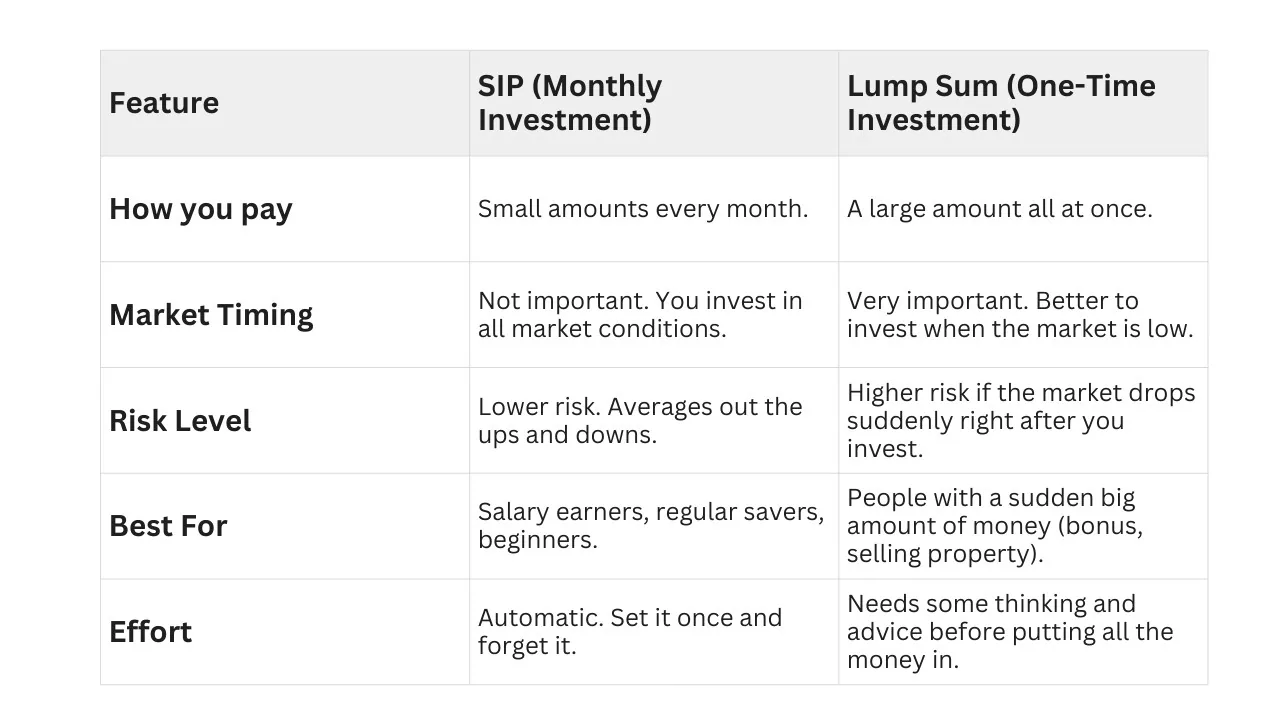
SIP vs Lump Sum: A Quick Comparison
To make things even easier to understand, lets look at a simple table that compares the two.
Breaking Common Investment Myths
In our 15 years in Tamil Nadu helping people with portfolio management, we have heard many false stories about investing. Let’s clear up some of these common myths so you can make smart choices.
Myth 1: "I need to be rich to invest in mutual funds."The Truth: Not true at all! With an SIP, you can start your wealth building journey with just 500 rupees a month. You do not need to be rich to start; you just need to start to become rich.
Myth 2: "If I miss one month of my SIP, my account will be cancelled."The Truth: Mutual funds are very friendly. If your bank account does not have enough money one month, the SIP will simply not happen for that month. There are usually no heavy penalties from the mutual fund company, and your old money is safe. You can just continue the next month.
Myth 3: "Lump sum is only for experts."The Truth: Anyone can do a lump sum investment. You just need a little guidance. If you have a large amount of money, an investment advisor can help you divide it up safely.
Why Not Both? The Best of Both Worlds
Here is a secret from the world of portfolio management: You don't have to choose just one! The smartest investors use both SIP and Lump Sum to build their wealth.
How does this work?
- Start an SIP with 20% of your monthly salary. This is your foundation. It runs quietly in the background, building your wealth month after month.
- Keep a little cash ready. When you get a Diwali bonus, or if the stock market drops suddenly because of some global news, use that chance to make a Lump Sum investment.
By mixing both, you get the steady discipline of the SIP and the extra boost of the Lump Sum.
How Bright Vision Investment Services Can Help You
Managing money can sometimes feel like trying to read a book in a language you don't know. The stock market, mutual funds, rules, and forms can get confusing.
At Bright Vision Investment Services, we are proud to serve the people of Tamil Nadu and our hard-working NRIs around the world. We believe that professional wealth building should be easy to understand and open to everyone.
Here is what we do for you:
- Investment Advisors: We listen to your goals (like buying a house, children's education, or retirement) and suggest the right mutual fund for you.
- Portfolio Management: We keep an eye on your money. If a fund is not doing well, we help you make changes.
- NRI Services: We handle the special rules and accounts needed for Non-Resident Indians to invest safely in India.
- Easy Setup: We help you start your SIP or place your Lump Sum investment with zero headaches.
You have worked hard for your money. Now, it is time to let your money work hard for you.
Final Thoughts
So, SIP or Lump Sum?
If you have a monthly income and want to build a safe, steady habit—choose SIP. If you have a big pile of money sitting idle from a bonus or a sale—choose Lump Sum. Remember, the biggest mistake in investing is not making a choice between SIP and Lump Sum. The biggest mistake is waiting too long to start. The earlier you begin your wealth building journey, the more time your money has to grow into something beautiful.
We hope this guide made things clear and easy to understand.
Mutual Fund Disclaimer
Mutual Fund investments are subject to market risks, read all scheme related documents carefully. Past performance is not an indicator of future returns. The information provided in this blog is for educational and informational purposes only and should not be considered as a guarantee of returns or a promise of future performance. Please consult with a certified financial advisor before making any investment decisions. Bright Vision Investment Services adheres to all guidelines laid down by the Securities and Exchange Board of India (SEBI).
Explore more perspectives or talk to Bright Vision about your financial goals.
Explore all insights