

Originally published 3 February 2026. This educational article reflects its publication date; check current rules and suitability before taking action.
If you have ever asked, “How much SIP should I start?”, you are already on the right track.
But here is the honest answer: there is no one perfect SIP amount for everyone. Your SIP amount depends on 3 simple things:
- Your goal amount (how much money you want)
- Your time (5, 10, or 15 years)
- How much risk you are comfortable with (because returns can go up and down)
This blog will help you find a clear starting SIP amount, in simple words, with easy examples for people in Tamil Nadu. No heavy finance language. No confusing math.

First, what is an SIP (in simple words)?
SIP means Systematic Investment Plan.
You invest a fixed amount every month (example: ₹2,000 or ₹5,000) into a mutual fund scheme.
Why people like SIP:
- It builds a habit (like a monthly saving plan)
- It reduces stress because you do not have to “time the market”
- Over long time, your money may grow faster because of “money grows on money” effect (your returns can also earn returns)
Also, SIP is friendly for beginners because you can start small, then increase slowly.
Before choosing your SIP amount, ask these 5 questions
1) What is your goal?
Examples:
- Child education
- House down payment
- Marriage expense
- Retirement
- “I just want to build wealth”
2) When do you need the money?
- 5 years: short to medium
- 10 years: medium to long
- 15 years: long term wealth building
3) How much can you invest monthly, without pressure?
A SIP should feel like brushing teeth. Regular. Not painful.
4) Can you increase your SIP later?
Most people can. Salary increases, business grows, expenses reduce.
5) Are you ready for ups and downs?
Mutual funds can go up and down in the short term. That is normal.
A simple way to think about SIP for 5, 10, 15 years
Think of SIP like a “3-button remote”:
- Increase time = SIP amount can reduce
- Increase monthly SIP = goal becomes easier
- Stay invested longer = bigger chance for good growth (but still not guaranteed)
Time is powerful. Many people underestimate how much difference 15 years can make.
Quick reality check: Returns are not fixed
When we talk about SIP, people ask: “Tell me exact SIP amount and exact returns.”
In real life, returns are not fixed, and nobody should promise a fixed return.
So in this blog, wherever you see numbers, treat them as examples for understanding, not as a guarantee.
Also, mutual fund ads and communication must carry the standard market risk warning.
SIP amount examples for common goal amounts (5, 10, 15 years)
Below are illustrations to help you understand the SIP range needed for a goal.
We have used two assumed return rates only for learning:
- 8% per year (more conservative example)
- 12% per year (more optimistic example)
Real returns can be lower or higher. They can also vary year to year.
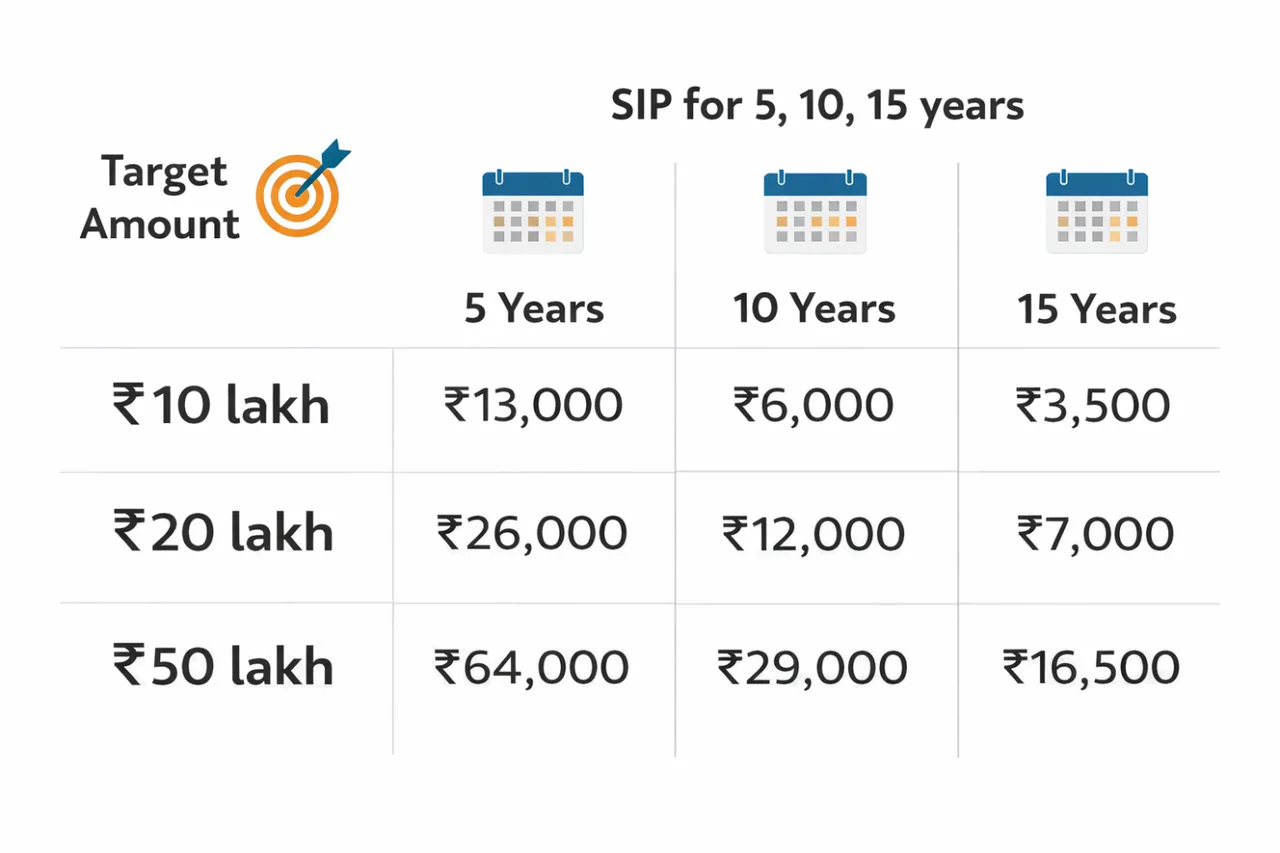
Example Table: “If I want this much money, what SIP may be needed?”
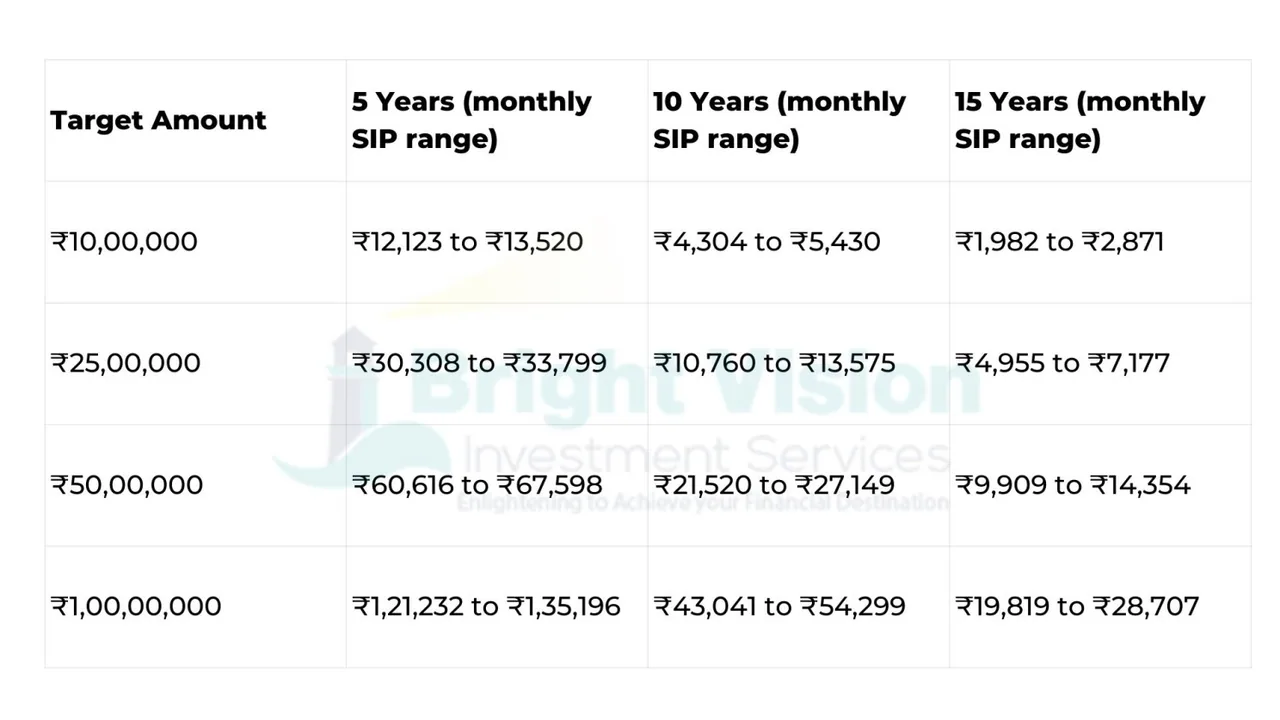
How to use this table (simple):
- Pick your goal amount
- Pick your time (5, 10, 15)
- Start with the SIP range that fits your monthly comfort
If you start with ₹2,000 or ₹5,000 SIP, how much money may build?
This table answers a very common question: “I can start small. How much can it become?”
Again, these are illustrations, based on assumed return ranges.
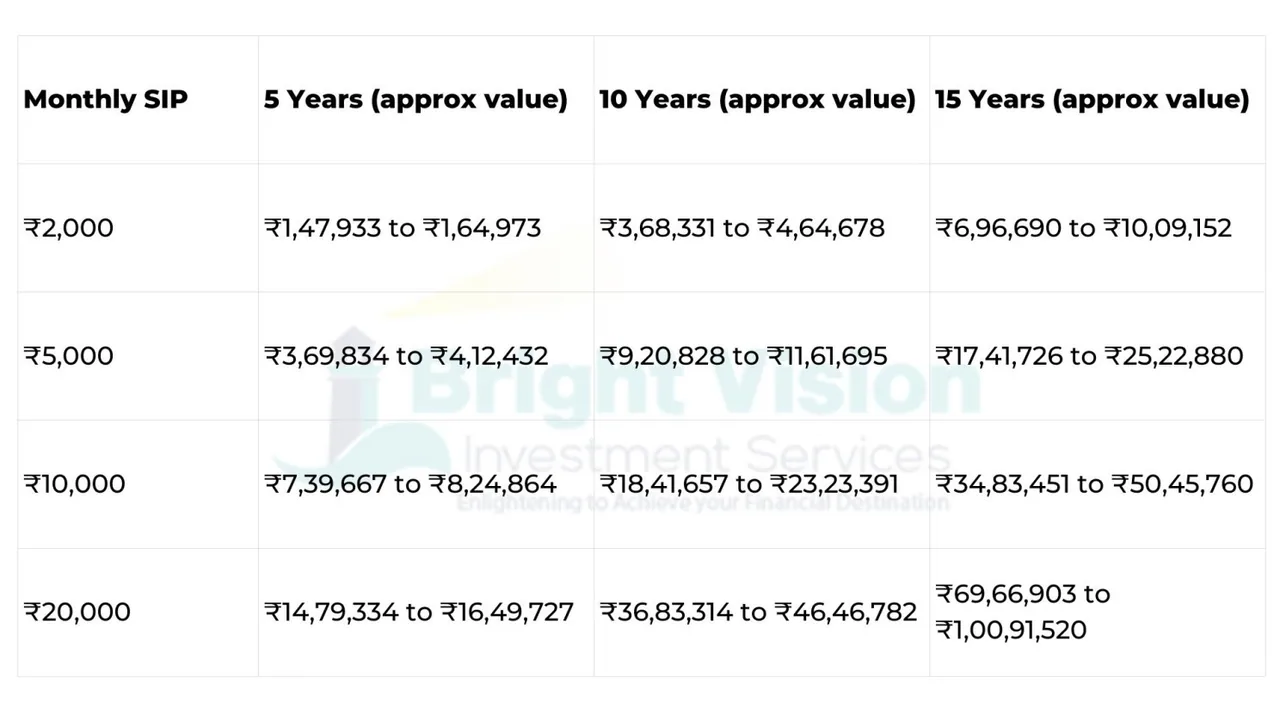
What you should notice:
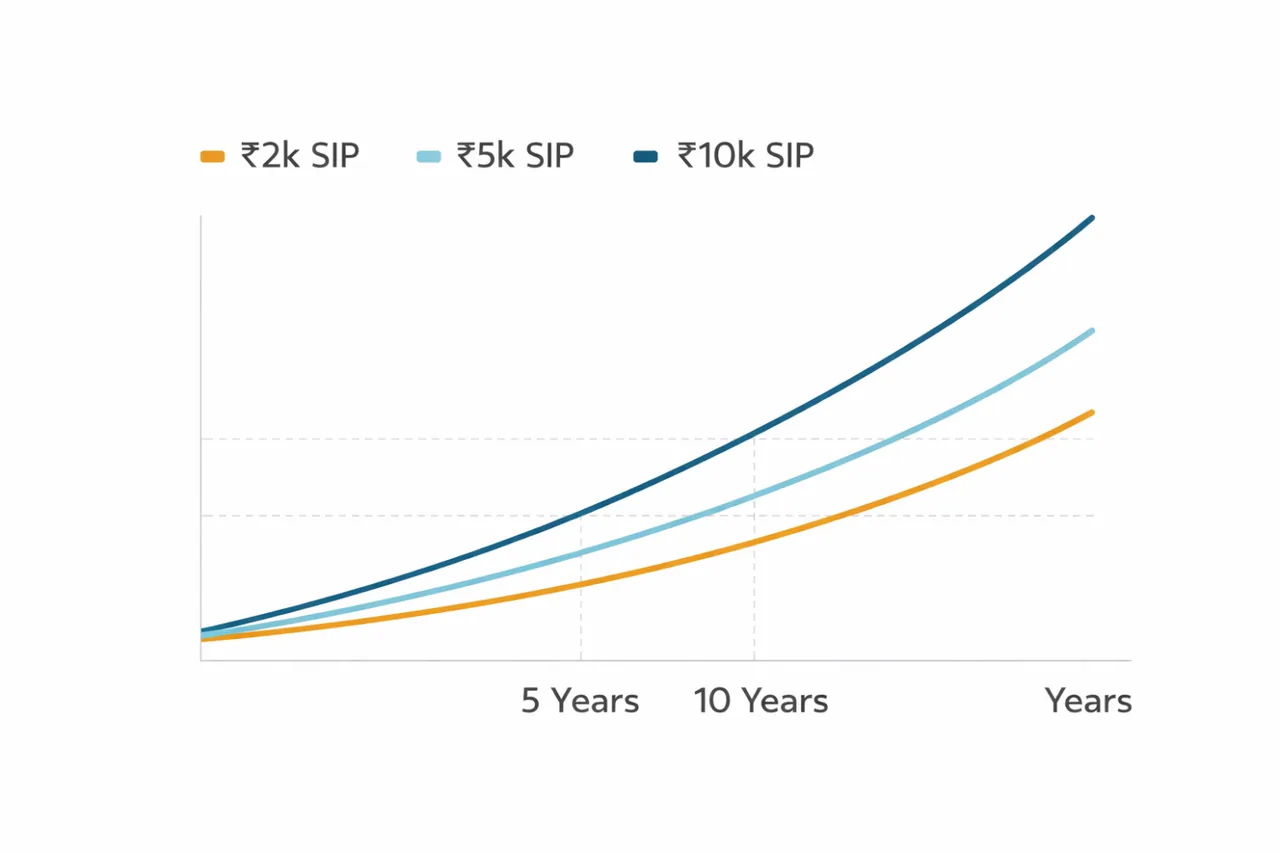
- 5 years is good, but 10 and 15 years can make a big difference
- A small SIP becomes meaningful when you give it time
The easiest trick: Step-up SIP (increase SIP yearly)
If you ask most wealthy families how they built wealth, you will hear this:
“I started small, then increased my SIP every year.”
This is called a Step-up SIP.
Example:
- Start SIP: ₹5,000 per month
- Increase SIP by 10% every year (as income grows)
This can feel easier than forcing a big SIP from day one.
Simple benefit: You start comfortably today, and you grow your investment slowly.
Easy example (illustration): A ₹5,000 SIP for 15 years vs a ₹5,000 SIP with yearly step-up can show a big gap over long time. (Numbers depend on market returns and are not fixed.)
How to choose SIP based on 5, 10, 15 years (simple guidance)
If your goal is in 5 years
- Focus on stability
- Avoid taking heavy risk just to chase higher returns
- A “mix” of safer and growth options is often considered (based on your risk profile)
If your goal is in 10 years
- You can balance between growth and stability
- You have time to handle market ups and downs
If your goal is in 15 years
- This is the classic wealth building period
- Time can help you ride out short-term market drops
Important: The right fund depends on your risk profile and goal. Avoid selecting funds just because someone said “this fund gave best return last year.”
Past performance is not a sure indicator of future performance.
Don’t forget inflation (price rise)
Even if your goal is “₹25 lakh”, in 10 to 15 years, prices may be higher.
Example:
- Child education fees rise
- Construction cost rises
- Medical cost rises
So, your goal amount should be reviewed once a year.
A simple habit:
- Every year, check if your SIP still matches your goal
- Increase SIP if needed
For NRIs: How NRIs can start SIP in India (simple view)
If you are an NRI (living outside India), SIP is still possible, but there are steps like:
- KYC and bank account details
- FATCA declarations (common in global compliance)
- Choosing the right account type for investing
- Understanding rules for sending money back (repatriation, meaning sending money abroad if needed)
The good part: once set up, SIP can run smoothly, and you can track everything online.

Common mistakes people make with SIP (and how to avoid)
1) Starting too late
Even ₹2,000 started today is better than ₹0.
2) Stopping SIP during market falls
Market falls are uncomfortable, but SIP is designed to handle ups and downs.
3) Choosing SIP amount without a goal
A goal gives clarity. Without it, people stop early.
4) Not having an emergency fund
Before aggressive investing, keep a basic emergency buffer for sudden needs.
5) Expecting “fixed returns”
Mutual fund returns are market-linked. No fixed return promise should be made.
A simple “SIP amount” shortcut (when you are confused)
If you don’t know your exact goal yet, start like this:
- Start SIP with a comfortable amount
- Pick a time: 10 or 15 years
- Increase SIP once a year
- Review yearly
Many people in Tamil Nadu start with:
- ₹2,000 to ₹5,000 per month if they are beginners
- ₹10,000+ per month if they have stable income and clear goals
Not as a rule. Just as a practical starting point.
How Bright Vision Investment Services can help
At Bright Vision Investment Services, we focus on:
- SIP planning for wealth building
- Goal-based mutual fund planning
- NRI support (start, manage, track)
- Portfolio review (to check if your plan matches your goal)
A simple way we work:
- Understand your goal and time
- Check your comfort level for ups and downs
- Suggest a goal-based SIP plan (without false promises)
- Review yearly and adjust
FAQ
1) Can I start SIP with ₹500 or ₹1,000?
Some schemes allow small amounts. But whether it is “enough” depends on your goal and time. Start small if needed, then increase.
2) Is SIP better than lump sum?
SIP is often easier for most people because it builds discipline and reduces timing stress. Lump sum can also work, but it needs planning.
3) Should I do one SIP or multiple SIPs?
Start simple. Too many SIPs can become hard to track. A goal-based plan can decide how many are really needed.
4) Can I stop SIP anytime?
Most SIPs can be stopped, but staying consistent is usually better for long-term goals.
Mutual Fund Disclaimer
Mutual Fund investments are subject to market risks, read all scheme related documents carefully.
Explore more perspectives or talk to Bright Vision about your financial goals.
Explore all insights